Ads

Showing posts with label Grammer. Show all posts

Saturday, May 11, 2013

Critique Partners and Bonus Saturday Happiness!

I'm so lucky. Really - I am.

I have the fun/joy/honor/privilege of critiquing for not one but TWO amazing writers. And they both are amazing, knock your socks off writers! Man - I wish I could tell you their names. I wish I could tell you the names of the books I'm critiquing for them. But I can't. At least, not right now.

So here's the funny thing about the critiquing I do for them: I don't pay any attention to the spelling or punctuation errors. I don't get into the nits and grits of syntax and style. I might point out a word here or there that I think seriously detracts from what they are saying, but mainly I ply them with questions. Things like "why did the cactus hurt?" or "that doesn't sound like something that character would say."

See, they know they need to edit their own work. They know they have to comb through for all the conflicting tense and verb usage. They don't need me for that. They need me (I like to think) to challenge the story itself. To question and poke and prod and point out the bits that don't flow, don't sound true to the rest of the story and don't support the overall plot or character arch. They need me to say "add more here so I know what the character is feeling" or "wow, you over did the emotions/descriptions here and lost the momentum."

They need me to move from draft to final - same as I need them.

As writers, we mostly know when we have a good story. We know how to develop a character and set a scene, how to move the story along or slow it down. But we also can get a little near-sighted and assume our readers have the same point of reference as we do. And they don't. They can't. They aren't us. They haven't lived our lives, experienced what we've experienced or even known the people and places and events that we have experienced.

Many of our readers may come close to mirroring our scope of reference, but none of them will have an identical range of reference in their lives. And this live-long knowledge, this personal collection of experience colors how we read. It allows each of us to feel and visualize and savor a book, a poem, a short story or a photograph in a unique way.

As writers, we need to keep that in mind. We need to ensure our writing provides enough points of reference and sufficient detail to allow all of our readers to grasp the images we are striving to portray. It's a delicate balance - often a difficult one as well. We don't want to put too much detail in, as it can make the reading stilted and cumbersome. Sometimes it even insults the reader - I know I've read plenty of books where I've thought to myself "well duh, I knew that. Why does the author feel they need to explain this to me?"

I don't want to insult my readers - I don't want to leave them with a half-sketched image and I don't want to describe everything in such detail that I end up with a Mitchner-esque tomb. I rely on my CP's to help me keep the balance and keep the story enticing. I rely on them to keep me honest to the craft.

So, here's to my Critique Partners - I hope I'm asking the right questions (should that be "write" questions?) and making the right comments. Now, let's go find an editor!

Bonus Saturday Happiness:

Tuesday, April 30, 2013

Revising and Editing...


Okay. I HATE editing. Really. It makes me feel like this:


Don't get me wrong; I do edit. I just don't LIKE doing it. When I write, it's verbal vomit. It all comes out in a rush (or several periods of rushing) and I just go with it. I don't worry about grammar or punctuation or spelling. I let the story and the character and everything else flow out; all the emotion and the world building and the vision exiting my finger tips and magically appearing in black and white on the screen in front of me.

I run spell check. I even run the grammar check tool. But at some point, I have to break out the red pen and read the damn thing. And I still don't mind that part. I do like reading what I wrote. Sometimes I laugh. Sometimes I cringe. Sometimes I even wipe tears from my eyes. It's the pen, and the marks on the paper and the notes asking myself why I wrote something or marking where I need to add more. It's the time that I have to put into the process that I resent. Time taking me away from the creative element, from crafting new stories and tales. That's the part I really hate about editing and revising.


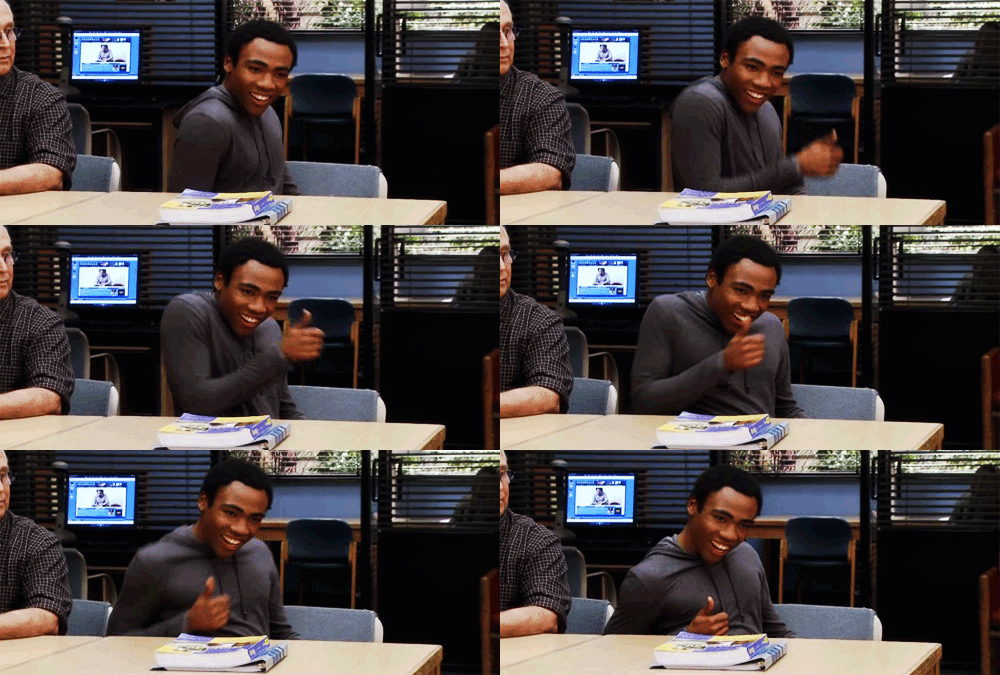
I want it perfect the first time, every time. Like this:


thumb is up


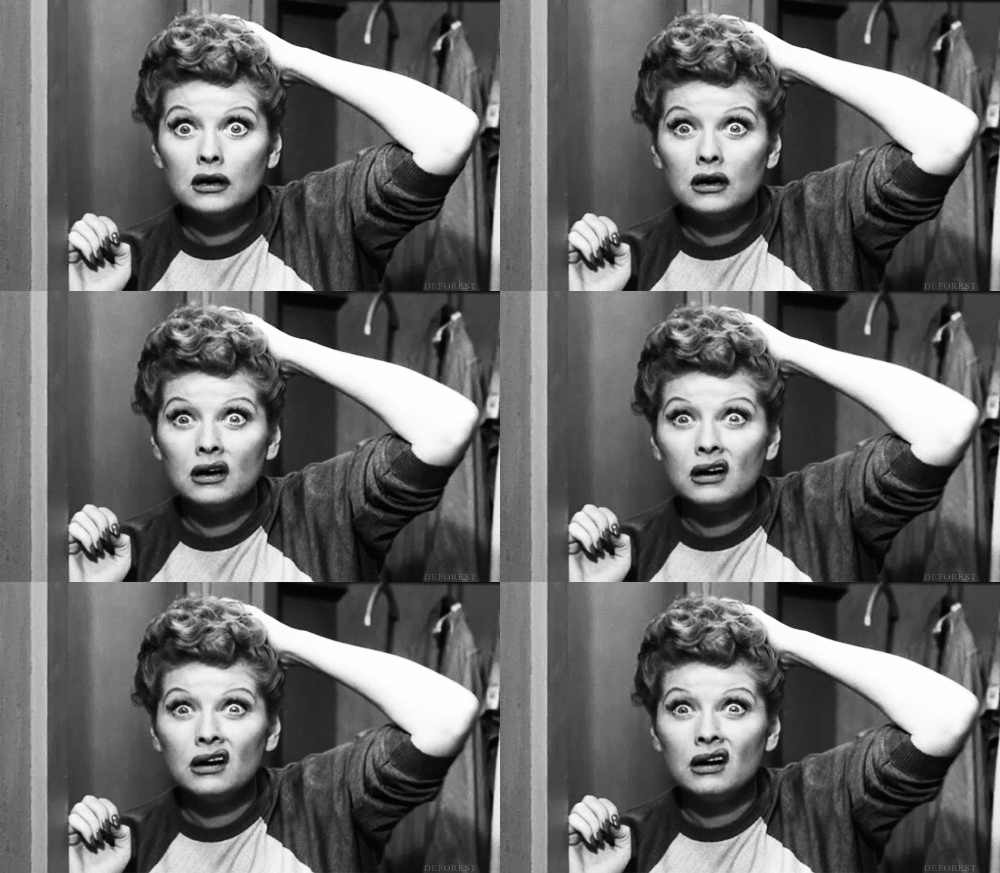
But more often it's like this:


Lucy snarl


So what's a writer to do? Well, there aren't that many options. Oh, sure, if I had the bucks, I could hire an editor. But I don't. I could subject my Critique Partners to my first drafts. But that's a good way to lose CP's quickly. I could write slower or more carefully or with less Scotch. Naw. We all know THAT'S not going to happen!

So, I'm stuck. And I'm revising. And editing. And learning to appreciate it as part of the overall process. To see it as "IMPROVING" instead of tedious, time-consuming, brain-draining necessity.


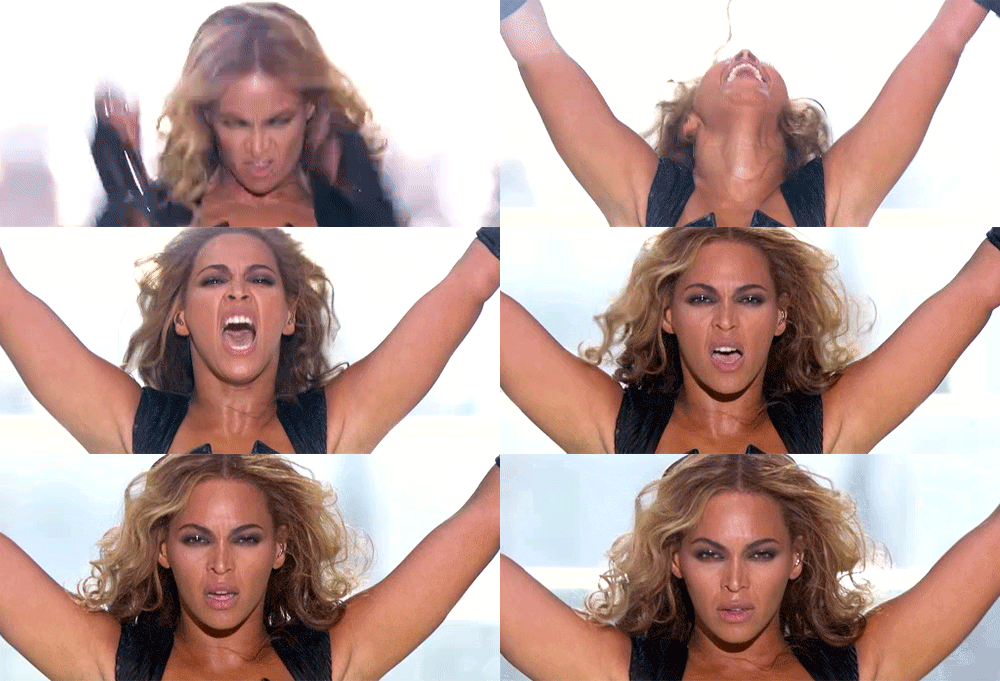
And hopefully, in the end, I'll end up here:


Beyonce fierce


But until then, I hate it. Really. And I put it off as long as I can. And even when I do it, I miss stuff. Even when I revise, I feel like it could be better. Or I shouldn't have cut/changed/added what I cut/changed/added. Or like I'm never going to get it done. Get it good enough. Get it out "there." After all - I'm one of them, one of you, one of us. I am, truly, an insecure writer.
 
Guess I'm in the write place.


Friday, April 19, 2013

Quality in Writing

Quality n. 1. (degree of) excellence. 2. characteristic, something that is special in a person or thing.

I've worked in the field of Quality for over thirty years. I've been responsible for the quality of valves used in the oil industry, the quality of cans and tubes used for dispensing medicine and the quality of advertising media. The most important job I've had, and my area of specialty, is in the quality of work performed on ships of the U.S. Navy. It's the subject I know best, the job I've held longest and the one that really matters to me.

When I watch a ship we've worked on sail away, all the equipment operating, all the sailors safe and confident in their ability to perform, I derive a deep sense of satisfaction. It's important to me to have a job that matters. So, when it comes to the Quality of the written word, I take inordinate pride in both my own writing and the writing of others. Most of my writing is policy, most of my reading is fiction. Somewhere in between I decided to marry the two and now I spend all my free time trying to become a Quality Writer.

We writers are a funny bunch. We can tear apart a sentence, paragraph, or novel until nothing remains but the shred of meaning that fomented it's creation. We can toss up grammar, punctuation, syntax and plot errors that no one else would think about. And we are our own worst critics - in both the best and worst ways. We recognize Quality, whether we can define it or not. We demand it in others, fight for it in ourselves and cringe at it's absence in both.

Quality in writing is, minimally, the accuracy of the use of those rules we learned in school. Every sentence needs a subject. Semi-colons must have a complete, relatable sentence on either side. Dangling participles will condemn you to hell. And we break many of those rules willingly.

Sometimes we break these rules for "effect;" to convey a mood, pacing or other nuance to the reader. Sometimes we break them without intent, because in the heat of the moment we don't pause to think about the structure of our writing (raises hand guiltily on both counts). Regardless of the violation, do these violations constitute Poor Quality?

I don't believe they do, and here's why: true Quality lies not in the accuracy of the written word. True, if you have enough errors in all of the rules, you will frustrate and lose your reader. If you have significant violations, either in quantity or severity, your writing will lose impact. But if you have reasonably accurate adherance and follow basic principles of plot, pacing, character development and subject, you can have high quality writing concurrent with grammatical error.

And that's the key: Quality writing is about the amalgamation of the words, sentences, punctuation and placement. It's the difficult to describe element that grabs the reader by the gut, makes them care about the subject of the story and keeps them turning the pages. It's the ability to relate to the people or the circumstance that you are writing about. Good writers of all genres may be grammatically accurate, providing "Quality" manuscripts. Great writers, truly Quality writers have developed sufficient style and dialogue skills, world-creating description and compelling plot-lines that allow them to break some of these rules and bend others to keep us moving to the end, leaving us wanting more.

Quality, then, is less a definitive degree of accuracy and more a managing of the intangible elements of our art. It's in the margins, in the nuance and subtext, and in the heart of the writer and the reader.

Go forth, ye writers, and create great Quality of written word!

“Raise your quality standards as high as you can live with, avoid wasting your time on routine problems, and always try to work as closely as possible at the boundary of your abilities. Do this, because it is the only way of discovering how that boundary should be moved forward.”
Edsger W. Dijkstra

Saturday, April 6, 2013

"E" is for Effect...And most people missed it!

Yesterday, as part of the A to Z blog challenge; I purposely skipped the letter "E" and went straight to "F" - and no one noticed. At least, no one said that they noticed. I even tweeted about it, with zero comments.

So, either no-one's reading or no one thought enough about it to say anything. Maybe you thought I had a temporary break from usual pedantic logical self. Not too far fetched, if you really know me, but not the case.

Maybe you found my Fabulous Friday of Musical Fare more entertaining - also unlikely. My Blogger Dashboard shows plenty of traffic yesterday. My Twitter Feed indicates some of you really do read my blather. So what gives?

I can only think you found other fodder on the blogosphere more tempting and comment worthy. And that's OK! I pulled my alphabetical slight of hand for effect, not for numbers and feedback. Because really, as writers, words and punctuation are the only means we have to deliver effect.

I worked with a critique partner a little while ago who didn't get my use of either - I had to drop her eventually. I have my own style, my own means of pacing both the scene and the story, and she was a grammar/punctuation virtuoso who could not cope with my purposeful warping of style. Don't get me wrong, she was very nice, very intelligent. I did garner some excellent feedback from her, but she absolutely could not comprehend why someone would voluntarily bend or break the laws of grammar.

Here's an example. This is a paragraph from my latest WIP, as I wrote it:


        I grab the trash can and start emptying the guac into it. It sticks to the bowl, congealed. Solid. I bang it against the side of the can, but it won’t come out. I throw the entire bowl in the trash. I grab the tuna casserole, look at the glass dish it came in and throw it in the trash on top of the guacamole. I grab the mac and cheese, the salad, the soup and the pie and the jam and the mayonnaise and I throw it all in the trash.
I hear glass breaking and I’ve missed the can and I’m standing in a pile of broken glass and food and bits of foil and plastic wrap and I’m throwing everything in the trash and the tea kettle’s whistling and I can’t stop yelling, screaming, cursing, calling him names and swearing at him and asking him why? Why did he leave me? Where did he go? Why couldn’t he take me with him? How could he leave me? How could he go away and leave me? Why can’t he come back? What do I do now? What the hell am I supposed to do now? How could he do this? How could he be so fucking selfish? I hate him! I hate him! I don’t care, I don’t care, I don’t care if I never see him again. Where is he? Where is he? Oh God, I need him and he’s gone. He’s gone. He’s gone.

Hopefully, at this point your stomach is clenched, your breathing a little faster and you are seriously emoting with the main character.


Now, here is the same paragraph, as she corrected it:

      I grab the trash can and start emptying the guacamole. It sticks to the bowl, congealed and solid. I bang the bowl against the side of the can, but it won’t loosen. I throw the bowl in the trash. I pick up the tuna casserole looking at the glass dish it came in. I throw it, too in the trash, on top of the guacamole. I grab the mac and cheese and the salad, then the soup and the pie and finally the jam and the mayonnaise, throwing all in the trash with the other items.
I hear the sound of glass breaking. I’ve missed the can and now I’m standing in a pile of broken glass.  Food and bits of foil and plastic wrap lie all around me. I was throwing everything in the trash and the tea kettle started whistling.  I couldn't stop yelling.  I was screaming and cursing.  I was calling Jamie names and swearing at him.  I was asking him why he left me? Asking where he went and why couldn’t I go with him? 
        I wanted to know how he could have left me and why he couldn't return to me. I kept asking what I should do now? I hated him at this moment. I didn't care that I would never see him again, but at the same moment I knew all I wanted was to see him again. 

A little flat, right? I mean, not horribly - you still get the intent and the drama, but you lose that emotional gut-check on her sanitized version. And at this point in the story, I need you to have that feeling. I need you to be completely absorbed in the main character's emotions. The story doesn't work without it.

This is the difference when you write for effect - when you consciously choose specific grammar, syntax and punctuation to create the emotional mood or element the story needs. 

In this case, I needed the reader to connect to the main character, to understand the raw power and conflicting emotions that terrible loss can bring to bear. Cleaning up the spelling and adding proper style elements doesn't get us there. We have to write for effect. All. The. Time.